
Brown County Civil Docket Searches
Open Indiana MyCase and narrow the court to Brown Circuit Court. The best search uses the full cause number. Next best is an exact party or business name. An attorney search can pull up matters tied to counsel. Official tips allow a trailing wildcard when you only know part of a name. Just skip the wildcard if you are using sounds-like search. Before opening the CCS, verify the Brown court identifier 07C01. Check the filing date, case type, caption, and status too. Broad searches can hit the portal's result cap. A tight filing range and a case-status filter cut the noise. MyCase can also search number history when a transferred case got a new number.
- Open MyCase and choose Case, Name, or Attorney.
- Select Brown Circuit Court and enter the strongest known search term.
- Check the case header and civil type code.
- Open the CCS and read all later settings and orders.
- Contact the Clerk when the needed nonconfidential paper is not linked.
Brown Civil Codes Tell the Route
Brown County runs a single trial court of record. The type code marks the kind of civil docket rather than pointing to a separate civil court. PL stands for civil plenary. CT stands for tort, CC for collection, MF for mortgage foreclosure, and MI for miscellaneous civil. Small claims carry SC, and evictions carry EV. Domestic relations cases use DC when children are involved and DN when they are not. Estates may appear as ES, EU, or EM, guardianship as GU, trusts as TR, and protective orders as PO. Tax matters use TS or TP. Take 07C01-2406-CC-000321, a sample June 2024 Brown collection number. It is not a real case. The Brown filing page spells out the local types and current filing routes.
Civil Dockets: What They Show
Think of the CCS as a chronological index to a civil case. It records what was filed or ordered and when the clerk entered the event. What it does not do is reproduce every complaint, answer, exhibit, or signed order. A short entry can omit terms that control the result. So read any linked paper alongside its event line.
| Case number | The 07C01 court code, date segment, civil type, and sequence. |
|---|---|
| Parties | Plaintiff, defendant, petitioner, respondent, and recorded counsel. |
| Filings | Complaint, petition, answer, appearance, service, and later motions. |
| Settings | Motion hearing, status conference, trial, small-claims, or eviction date. |
| Disposition | Judgment, default, dismissal, settlement order, or satisfaction. |
A filing is not a ruling. A hearing notice is not a judgment either. Before you describe the status of a case, read the current order and every entry after it.
Brown Small Claims Notice Fields
The official Brown small-claims form doubles as a map of this local docket. It asks for the claim amount, the interest date and rate, hearing date and time, service choice, claim category, attachments, party contact details, and a perjury affirmation. Certified mail or sheriff service can show right on the face of the filing. Its instructions set real deadlines. A defendant's written jury demand is due within ten days after the notice is received, and if granted, the added transfer fee must be paid within ten days. A counterclaim may not exceed $10,000. Continuance requests should be written and copied to the other party. A no-show plaintiff risks dismissal. A no-show defendant risks default judgment. Evictions and past-due rent claims fall squarely within Brown small claims. That is a classification and procedure point about how the court handles the case. Use the CCS to track your own case, its service, setting, judgment, and later satisfaction.
What Cases Fill the Civil Docket
The civil mix at Brown Circuit Court is broad. Every kind shares the unified Clerk and the same Brown court identifier, though filing steps and access limits differ from one type to another.
| Brown civil group | Common codes | Docket focus |
|---|---|---|
| General civil | PL, CT, CC, MF, MI | Complaint, service, motion, setting, judgment |
| Small claims | SC, EV | Notice, service, hearing, default or judgment |
| Family | DC, DN, PO | Petition, orders, settings, restricted details |
| Probate | ES, EU, EM, GU, TR | Petitions, appointments, inventories, court orders |
| Tax and other | TS, TP, XP | Verified filings, orders, disposition, access status |
Adoption, juvenile, mental-health, guardianship, protection-order, and some family records need special care. Being noncriminal does not make them ordinary open civil files.
Brown Civil Filing Fees
The Brown filing page lists $87 for small claims, including eviction, plus $10 for each defendant and for sheriff service. Separate civil filing charges apply to plenary, collection, tort, foreclosure, and miscellaneous civil cases. These are costs to open a new case. They are not fees for buying a record that already exists.
| Item | Published amount |
|---|---|
| Small claim or eviction filing | $87 |
| Added defendant | $10 each |
| Requested filing copy | $1 per page |
| Certified or expedited record copy | Confirm with Clerk |
Want a certified copy fast? The Brown County Clerk does not publish an online cart, a set expedited price, or a guaranteed turnaround for copies. Call the clerk's office before you mail any payment. For statewide context, Indiana's trial court fee manual lays out the filing fees courts across the state may charge.
The state's own trial court fee publication shows the fee schedules in detail.
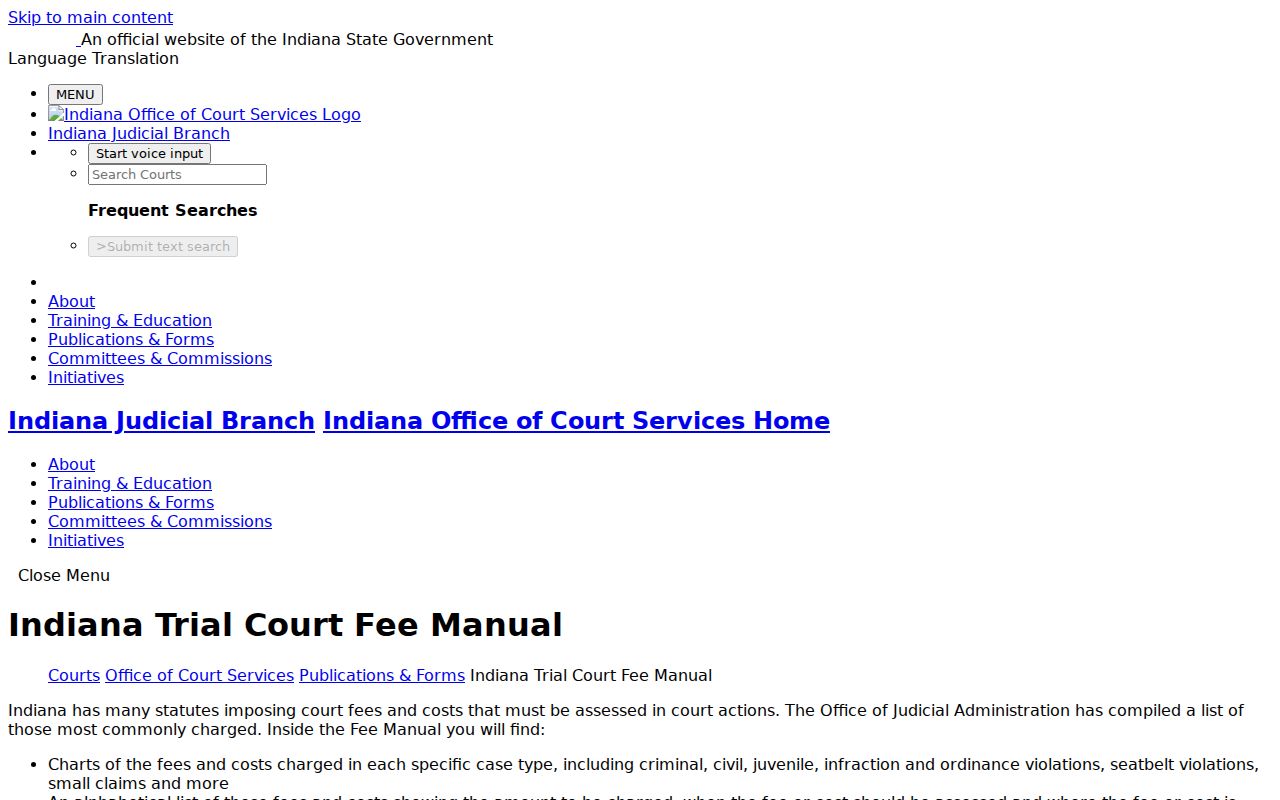
That distinction matters. Paying to file is not the same as paying for a copy from an existing file.
Brown Civil Filings Through Judgment
A civil CCS opens with a complaint, petition, or verified request. Service entries come next, noting summons, certified mail, sheriff service, waiver, or another authorized path. Appearances and answers reveal who responded. Motions, responses, discovery events, subpoenas, and signed orders then fill out the middle of the docket.
Docket flow: Complaint or Petition › Service › Appearance or Answer › Motions › Hearing or Trial › Judgment › Post-Judgment Work
The end can take many shapes. Disposition may arrive as a judgment, agreed judgment, default, dismissal, bench or jury result, or another final order. Proceedings supplemental, garnishment-related filings, a satisfaction, correction, or appeal can keep the docket alive after that. Brown publishes a proceedings supplemental form. It is a clear example of why activity continues after the main dispute is decided.
Brown Civil Defaults and Satisfaction
Outcome labels in a Brown County civil docket only tell part of the story. A default means someone missed a required response or appearance. Yet the CCS label by itself gives no dollar amount and no full account of the legal effects. Dismissal may be procedural or it may be final. An agreed judgment records a resolution the court approved. A later satisfaction or release shows the obligation was addressed.
- Default judgment
- A judgment entered after a required response or appearance was missed.
- Proceedings supplemental
- Post-judgment court work aimed at enforcing a judgment.
- Satisfaction
- An entry or paper recording that a judgment obligation was met or released.
- Continuance
- A request or order moving a setting; a filed request is not yet approval.
One more habit pays off. Always hunt for a later correction, vacation, appeal, or satisfaction, because an old judgment entry rarely describes where the case stands today.
Hearings on the Civil Docket
A Brown County civil docket can hold many kinds of settings. Motion hearings, status conferences, small-claims hearings, evictions, bench trials, and jury trials all appear. The CCS usually lists the date, time, judge, and hearing type for each. Brown County does not take part in the statewide public Court Calendar. MyCase plus a call to the court itself is the dependable local chain. A filed motion is not the same thing as a granted one. A party asking for a continuance should never assume the hearing date moved. The request going in is not enough. Brown provides a verified continuance form that includes a certificate of service. What matters is the judge's signed order and the replacement setting. Court staff can tell you the next hearing date. They cannot advise whether a motion should be filed. Note: After any continuance request, confirm the newest Brown County civil setting even if the old date still sits in an earlier notice.
Brown Civil Filings by the Numbers
Indiana's 2024 report counted 638 civil filings in Brown County across the displayed civil groups. Collections dominated, with 261 cases. Protective orders came next at 84. Then came 36 domestic-relations cases without children and 32 unsupervised estates. The rest included 28 miscellaneous civil matters, 27 foreclosures, 27 expungements, 24 plenary cases, 23 torts, 23 guardianships, 19 small claims, 17 evictions, and other categories.
That mix explains a real problem. "Civil" is too broad a word to predict access. A collection case and an adoption both sit outside the criminal docket, but Indiana's remote and in-person rules treat the two very differently.
Who Can See Civil Dockets
Nonconfidential Brown County civil CCS entries are searchable through MyCase. Collection, tort, plenary, foreclosure, tax, and some miscellaneous cases can offer nonconfidential orders. Other documents may be online too. Domestic relations, guardianship, protection-order, adoption, juvenile, and mental-health matters carry tighter restrictions. Check the current MyCase access table instead of treating every civil paper the same.
Indiana access framework:
Access Rule 4 presumes court records open unless another authority excludes them.
Access Rule 5 identifies excluded records, including entire categories and protected information.
Access Rule 9 supplies the court process for an extraordinary-access request.
When a public hearing shows no document link, ask the clerk directly. Pearletta Banks, Clerk of the Brown Circuit Court, handles those requests. Her Clerk office sits at 20 E Main Street, Nashville, Indiana 47448. Call 812-988-5510, fax 812-988-5511, weekdays from 8:00 a.m. to 4:00 p.m.
Mail requests work too. Give the cause number, the record you need, the event date, the copy form, and a return address or fax. That way the office can send it back.
For getting a civil case on the docket in the first place, the county's official filing page walks through the steps the Circuit Court expects.
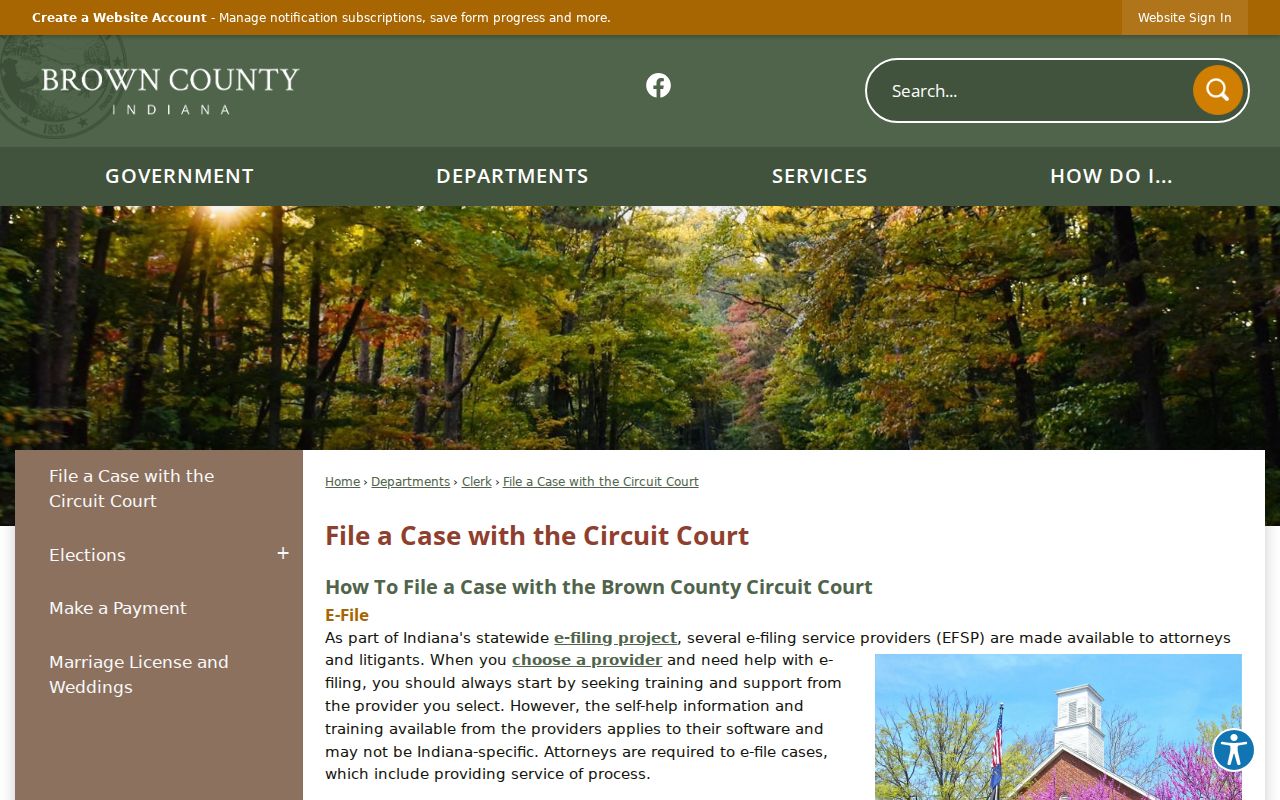
That official page confirms the routing. Filings and record-copy questions in Brown County go through the unified Circuit Court and Clerk rather than a separate civil clerk.